Ofcom reports, explained
Gate and feed: what nine months of UK age checks changed in what children see
We blocked adult sites for children and left them TikTok and Instagram. In other words, we left them bullying, hate and body shaming, and went after the 13 percent… Well done, us.
That is my short reading of two reports from Ofcom, the UK regulator. The first, from 21 May 2026, compares what children saw online before and after the new child-safety rules took effect. The second, from 22 October 2026, is the first statutory review after nine months of those rules. Both reach the same conclusion: the share of children who come across harmful content has not changed significantly.
Below are the key numbers from both reports, with page numbers so you can check them yourself. My own view comes at the end, clearly separated from the data.
What changed in the UK in July 2025
Since 25 July 2025, services that children can access in the UK must protect them from harmful content. That is the Online Safety Act, and Ofcom enforces it. The most visible result is age checks: a selfie, a face scan or an ID at the door of adult sites and of some social media features.
Children noticed. 51% of children with an account on popular services were asked to prove their age, up from 41%. Among them, 28% came across a face scan, compared with 5% before the rules (May report, p. 6).
Before and after: 70% and 73%
Every few months Ofcom asks 11-17 year olds what they saw online in the past four weeks. They get a list of types of harmful content and tick the ones they came across.
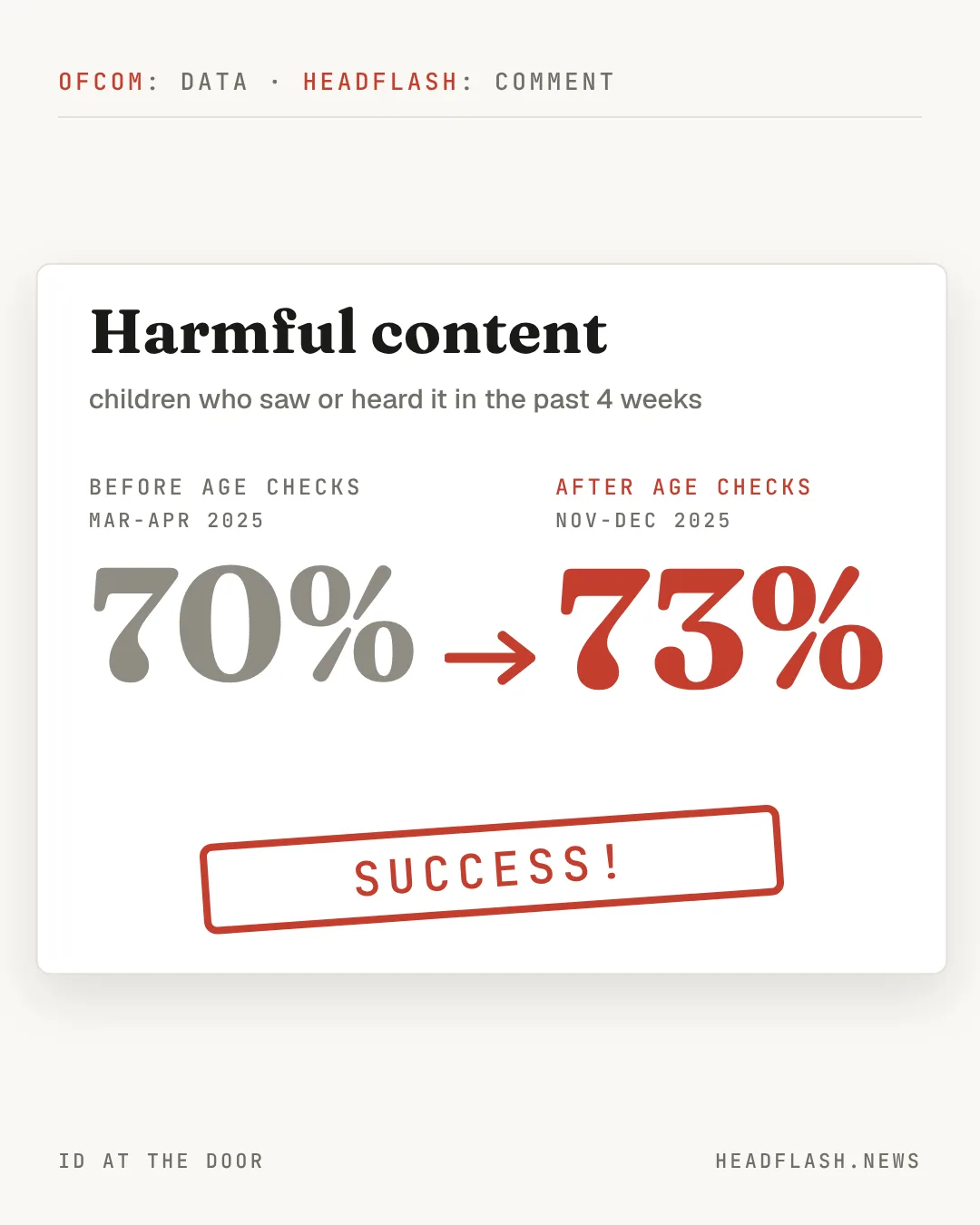 The share of children who came across harmful content in the past 4 weeks was similar before and after the age checks: 70% and 73%. Data: Ofcom, May 2026. Graphic from the HeadFlash film.
| In the past 4 weeks | Before (March-April 2025) | After (November-December 2025) |
|---|---|---|
| Any harmful content | 70% | 73% |
| Most harmful content (adult content, self-harm, eating disorders, suicide) | 30% | 31% |
| Bullying | 58% | 62% |
Ofcom treats the first two changes as not significant. Bullying is the only statistically significant rise (May report, p. 4).
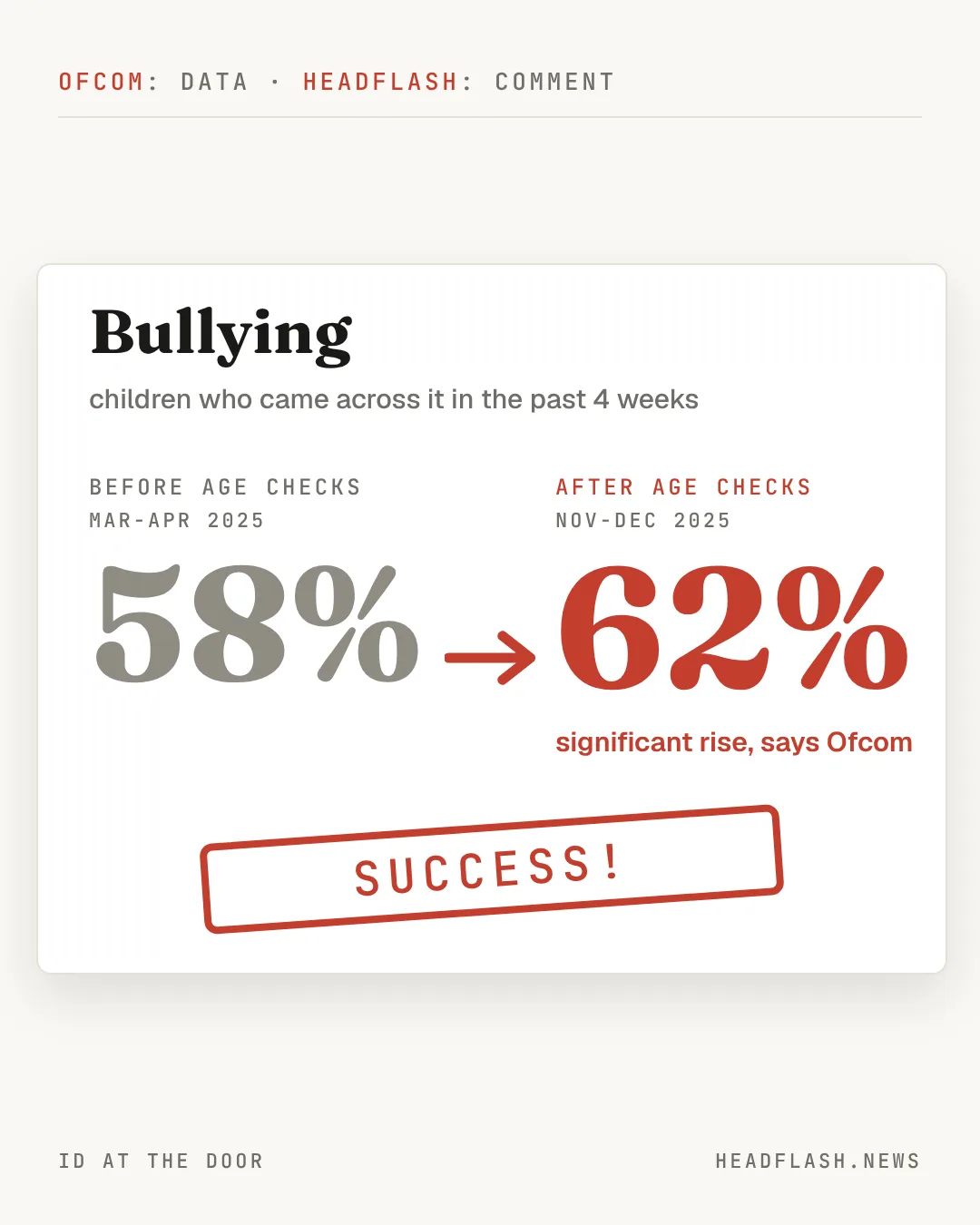 Bullying is the most common kind of harmful content, and Ofcom recorded a significant rise here: from 58% to 62% of children. Data: Ofcom, May 2026. Graphic from the HeadFlash film.
There is one improvement. Fewer children mention, unprompted, content that upset or scared them: 24% instead of 29%. Ofcom cautiously says this may mean less of the most extreme content.
The October report confirms the picture with the next survey wave, from March and April 2026: in the nine months since the rules took effect there is no significant change in how often children come across harmful content, and Ofcom has no new evidence of a change in how much it harms them (October report, p. 3).
What exactly they see
Survey from March and April 2026, 11-17 year olds, past four weeks (October report, footnotes in chapter 4):
| Type of content | Share of teenagers |
|---|---|
| Bullying | 61% |
| Hate | 49% |
| Body shaming | 42% |
| Dangerous challenges and stunts | 29% |
| Harmful substances | 26% |
| Violence | 25% |
| Content promoting depression | 23% |
| Content promoting eating disorders | 23% |
| Suicide or self-harm | 14% |
| Adult content | 13% |
Adult content is at the very bottom of this list. That is where the most visible gate was put up.
The gate works. It just stands in one place
On adult sites the checks do their job. In July 2026 most of the popular adult services in the UK checked age. In a month, 8% of online 8-14 year olds visited one, and around two thirds of those visits lasted less than 10 seconds (October report, p. 23). It looks like this: in, asked for age, out.
The gate can also be bypassed. 25% of teenagers say they used a VPN in the past six months, and 31% of 16-17 year olds. 5% say they got around an age check. Another 16% say they could (May report, p. 6). The reasons for using a VPN vary, from films not available in the UK to privacy.
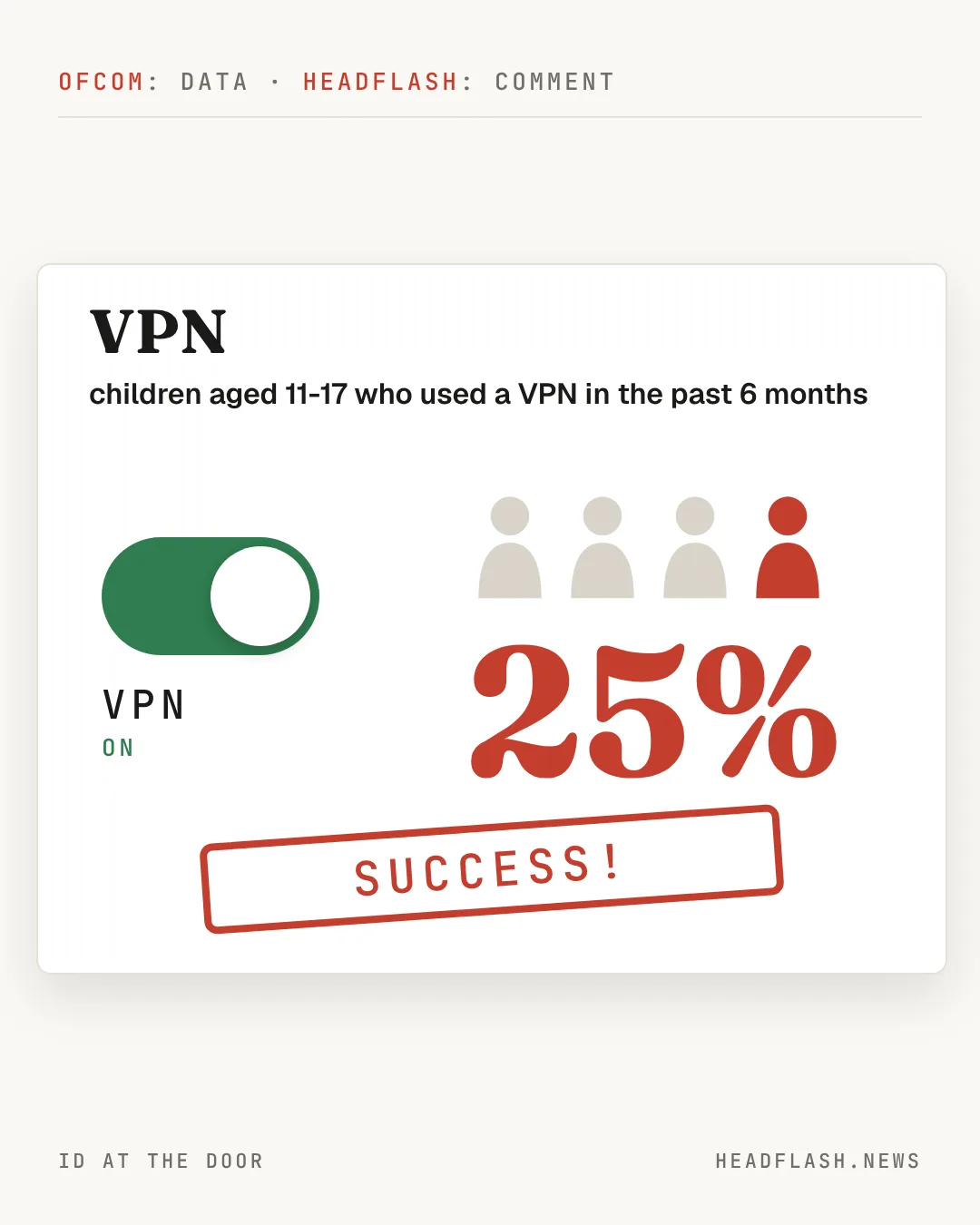 One in four children aged 11-17 used a VPN in the past 6 months, for a range of reasons. Data: Ofcom, May 2026 (survey from March 2026). Graphic from the HeadFlash film.
Yet the share of teenagers who saw adult content has not changed significantly. Ofcom says it plainly: children still come across it on social media, in messaging apps and in games, most often in their personalised feed, less often in comments (October report, p. 23). And 30% of children’s visits to adult sites start from a search engine.
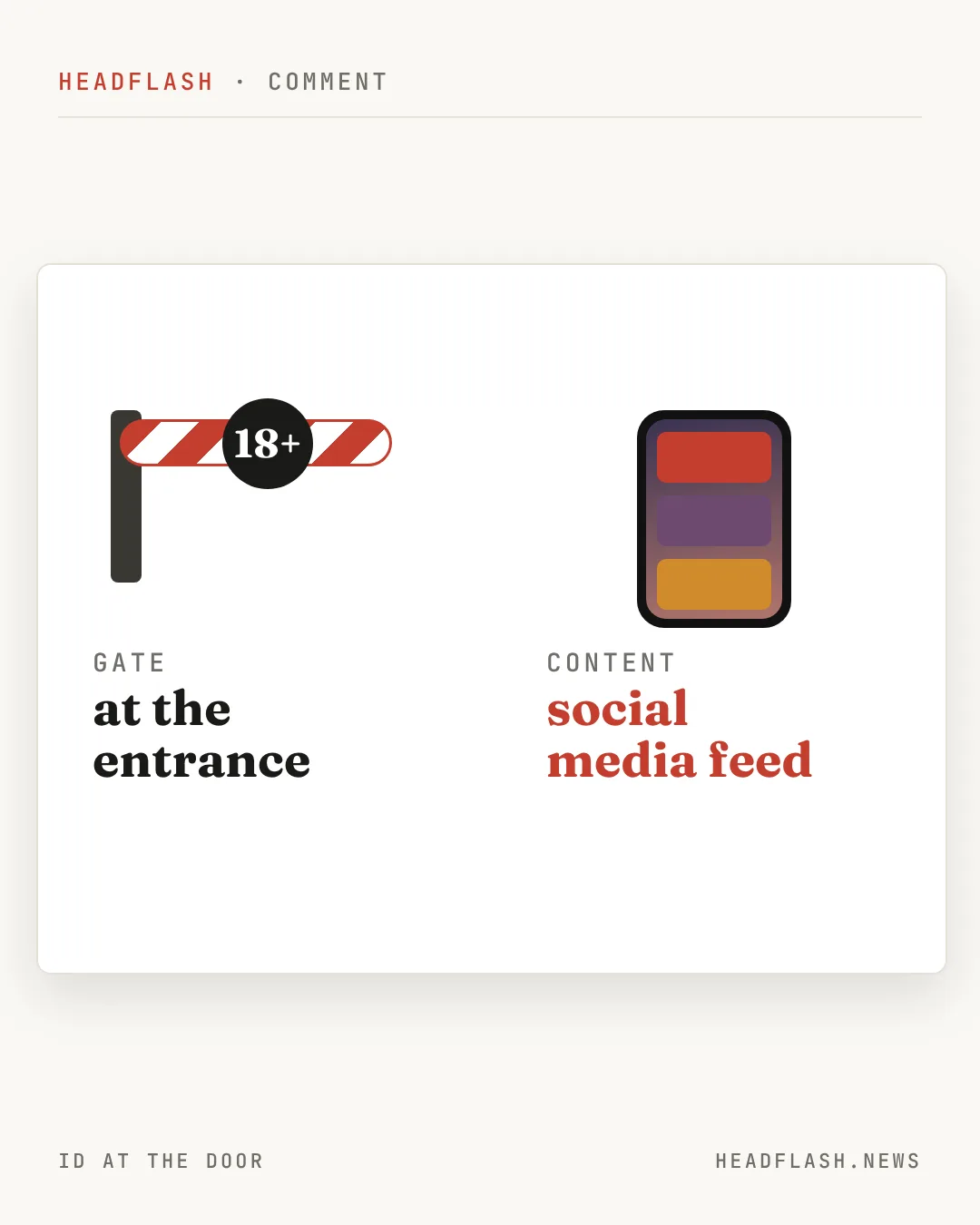 Age checks close the entrance to adult sites, while, according to Ofcom, children most often come across harmful content in the feed. Data: Ofcom, May and October 2026. Graphic from the HeadFlash film.
Where it comes from: the feed
The same sentence comes back in the report for almost every category, from self-harm and eating disorders to hate: children most often see it in their personalised feed. That is what Instagram, TikTok, Facebook or YouTube serve up for scrolling on their own, without any searching.
The May report has the numbers. The feed is the most common route, 35% (37% before). Comments grew from 14% to 21% (May report, p. 5).
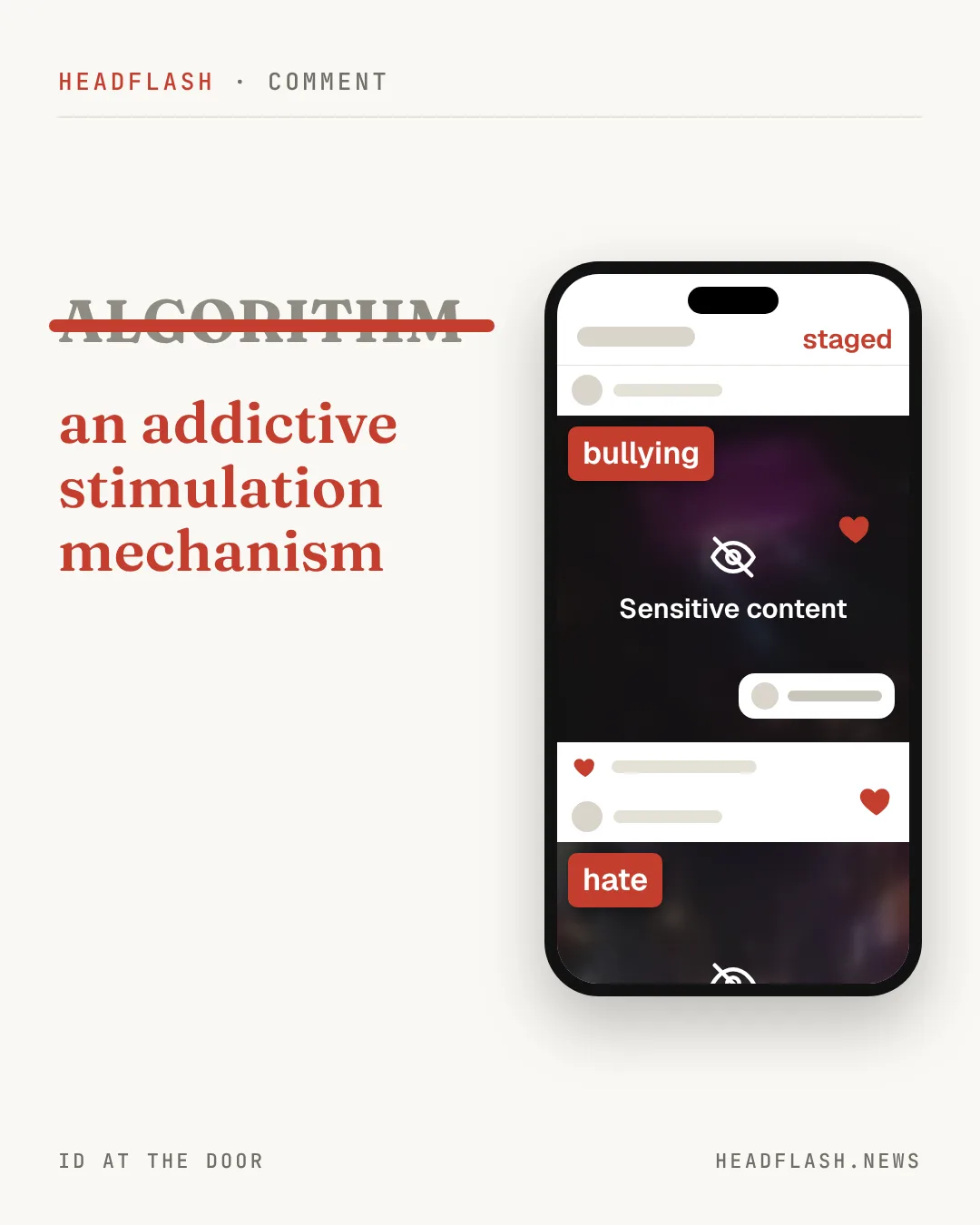 According to Ofcom, the feed is the most common route to harmful content (35% of children who saw it); the line on the graphic is HeadFlash's comment, and the feed is staged. Data: Ofcom, May 2026. Graphic from the HeadFlash film.
Ofcom also cites research on how this works. Boys who watch gym and self-improvement content can quickly end up with more extreme content, with misogyny and racism. Creators get past moderation with deliberately misspelled hashtags and coded language (October report, p. 31).
Which apps
Children who came across harmful content in the past four weeks were asked on which service it happened. Share of mentions after the rules took effect (May report, p. 5 and 21):
| Service | Any harmful content | Most harmful content, before and after |
|---|---|---|
| TikTok | 53% | 35% → 42% |
| YouTube (excluding YouTube Kids) | 36% | 32% → 25% |
| 34% | unchanged, 26% | |
| Snapchat | 31% | unchanged, 18% |
| 31% | 30% → 23% |
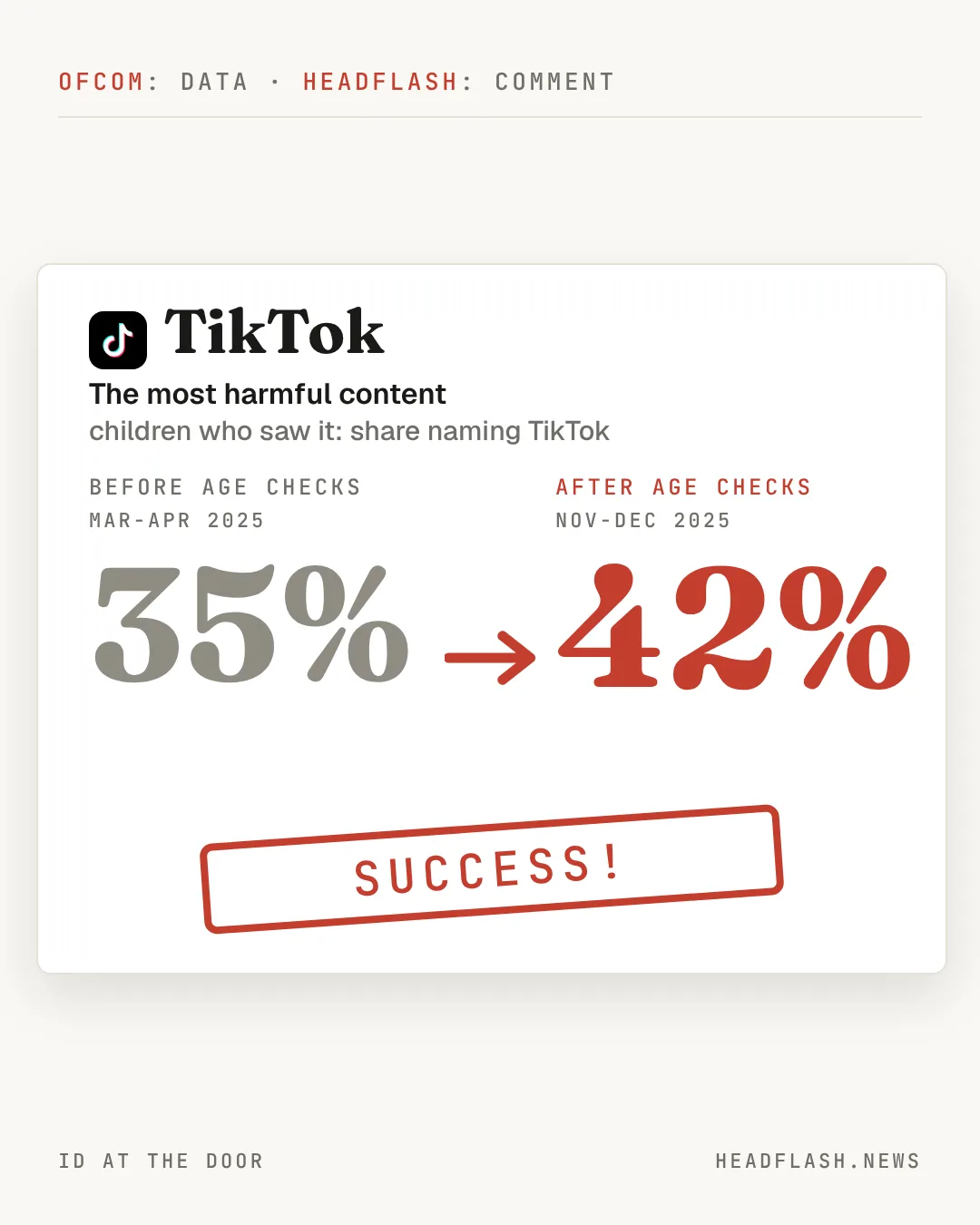 Children who saw the most harmful content named TikTok most often, and that share rose from 35% to 42%. Data: Ofcom, May 2026. Graphic from the HeadFlash film.
Ofcom notes that the ranking largely reflects how popular the services are. Still, two things stand out. More children name TikTok as the place where they saw the most harmful content after the rules than before. Facebook is the only service that children name clearly less often than before.
Counting only each service’s own users, X does as badly as TikTok: 61% of teenagers who use X saw harmful content there, and 60% of those who use TikTok.
What children do when they see it
Most often nothing: 47% scroll past. 59% take some action, for example tap “Not interested” (15%), block (11%) or report (12%). 87% of children know about reporting and 86% say it is easy. 27% of those who reported got a reply from the service saying the matter would be looked into, twice as many as before.
15% of children tell an adult, up from 10%. The rise is mostly among girls and 11-12 year olds (May report, p. 5).
What the regulator proposes
Ofcom recommends that the government add two new categories to the law: body shaming, and content promoting depression, hopelessness and despair. It proposes no other changes. It considered harmful conversations with AI chatbots and extreme violence, but did not add them (October report, chapter 3).
It also announces a report on how to check whether someone is 16 or older. The UK government wants to ban social media for under-16s (October report, p. 4). Next review: within three years at the latest.
My view
The feed does not arrange itself. And let’s stop calling it an ALGORITHM, as if it were the weather. It is an addictive stimulation mechanism built to keep a child on the screen as long as possible, and what keeps them there longest is hate, fear and comparing themselves with others. The platform sets it up, and the UK law puts the duty to protect children on the platform.
A gate at the entrance does not touch that mechanism. It closes one category, the smallest on the list, and even that one still arrives through the feed. Adding two items to the law will not change it either. The algorithm (sorry, the mechanism) will surely read the amendment and… adapt. And a ban for under-16s is the same gate, just one floor up.
As for VPNs: children who use one are unlikely to brag about it in a regulator’s survey. So I treat the numbers on getting around the gates as a lower bound.
The UK has just tested on its own children that an ID check at the door does not change what a child sees on their phone. So maybe the rest of Europe should not follow the same trend. We have the same apps and the same feed here too.
What you can do as a parent
Don’t ask which sites your child visits. Ask what their phone served them this week.
A gate or a filter will not do this for you. Only 15% of children tell an adult about what they saw, so most depends on whether your child comes to you with it. A few things you can do right away:
- Watch your child’s feed together. A few videos side by side tell you more than the app settings, and your child sees that you care about their world, not just about control.
- Agree on phone-free zones: the bedroom at night and the table at mealtimes. That goes for adults too, or it is hard to ask.
- Talk about what is on the screen: that not everything there is true, how to tell criticism from hate, and what to do with the pressure of likes.
- Watch for changes in behaviour: sudden withdrawal, sadness after putting the phone down, not wanting to go to school. A child who is bullied online often stays silent out of shame.
- Save a helpline number in your phone and in your child’s. In the UK, Childline is 0800 1111. In Poland and many other EU countries, the child helpline is 116 111. Illegal content can be reported anonymously to your national hotline, in the UK the Internet Watch Foundation.
Sources and limitations
- Ofcom, “Children’s Online Experiences”, 21 May 2026, 49 pages. Two waves of the Children’s Online Safety Tracker survey: March-April 2025 (before) and November-December 2025 (after), plus passive measurement of devices of 8-14 year olds. PDF on ofcom.org.uk
- Ofcom, “Report on content harmful to children”, section 63 Online Safety Act report, 22 October 2026, 85 pages. Third survey wave: March-April 2026. PDF on ofcom.org.uk
Limitations worth knowing:
- This is a survey. Children report what they remember from the past four weeks. Nobody measures what their phone actually showed them.
- The October report states explicitly that it does not assess whether services meet their duties or how effective individual measures are (p. 4). Nor does it say the rules “don’t work”. It says there is no significant change.
- Numbers from the two reports come from different survey waves. The tables always say which.
The text is mine, the numbers and quotes come from Ofcom’s reports.
About the author
My name is Marcin Rybak. Security and privacy are a passion for me, not a job. I run HeadFlash, a newsletter and podcast on AI, privacy and security. Nobody paid me for this text.
Questions, comments and corrections are welcome. I read every one.